Virtualucid
A self-hosted 3D community-world platform entered through a browser link. Go services and a Rust authoritative simulation own sessions, recovery, and world state.
Overview
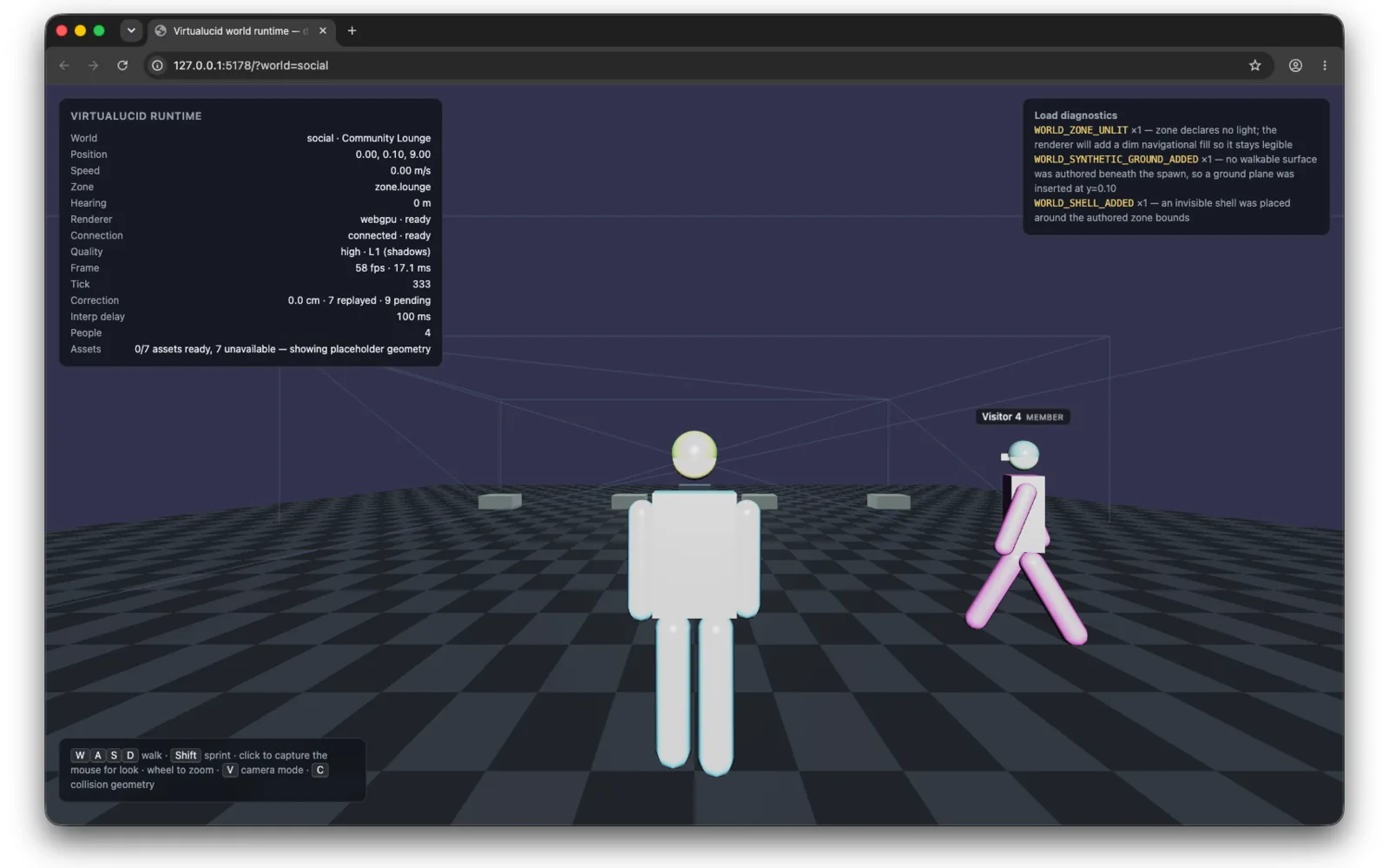
A self-hosted 3D community platform designed so a person or organization can run a world on its own node while participants join from a browser with no separate install. It connects a React/Babylon.js client, a Go control plane, WebRTC edge and Host Agent, and a Rust authoritative simulation, world compiler, and Wasm behavior sandbox in one executable path. The local real-room milestone proves two participants joining and moving, recovery after killing the simulation, hard reloads, and a real FIFO waitlist at capacity. Production media, object storage, deployment, and final art are not activated yet.
My Work
- ▸Designed and implemented the distributed-system boundaries across the browser, Go services, and Rust authority
- ▸Implemented admission, seats, waitlists, authority promotion, and checkpoint recovery contracts
- ▸Connected the World SDK, CLI, authoring MCP, and digest-bound release/download path
- ▸Kept verified local capability separate from production paths that are not activated yet
Features
- React/Babylon.js Lobby · Room · Builder · Studio browser surfaces
- Go control plane · Pion WebRTC edge · Host Agent process supervision
- Rust/Rapier authoritative simulation · checkpoint and journal recovery
- Deterministic World Package compiler · Wasmtime behavior sandbox
- An opt-in PostgreSQL 17 composition with 17 migrations and 37 tables
- Semantic Yjs collaboration across an isolated Rust/Yrs boundary
Highlights
- Two browser participants join one real self-hosted authoritative room and see each other move
- Both sessions recover after the simulation is killed and return to ready after hard reloads
- A third participant holds a real FIFO waitlist position when a capacity-two room is full
- PostgreSQL 17 · Yjs/Yrs collaboration · SDK/CLI/MCP share the same world contracts
Timeline
Tech Stack
</>Rust authority · Go control/realtime · React/Babylon.js · PostgreSQL · Yjs/Yrs