"I can do a prototype of Theme Park in half an hour now which took me six months back when I was 17. So why haven't we seen a kid making a hit game that sells ten million copies?"
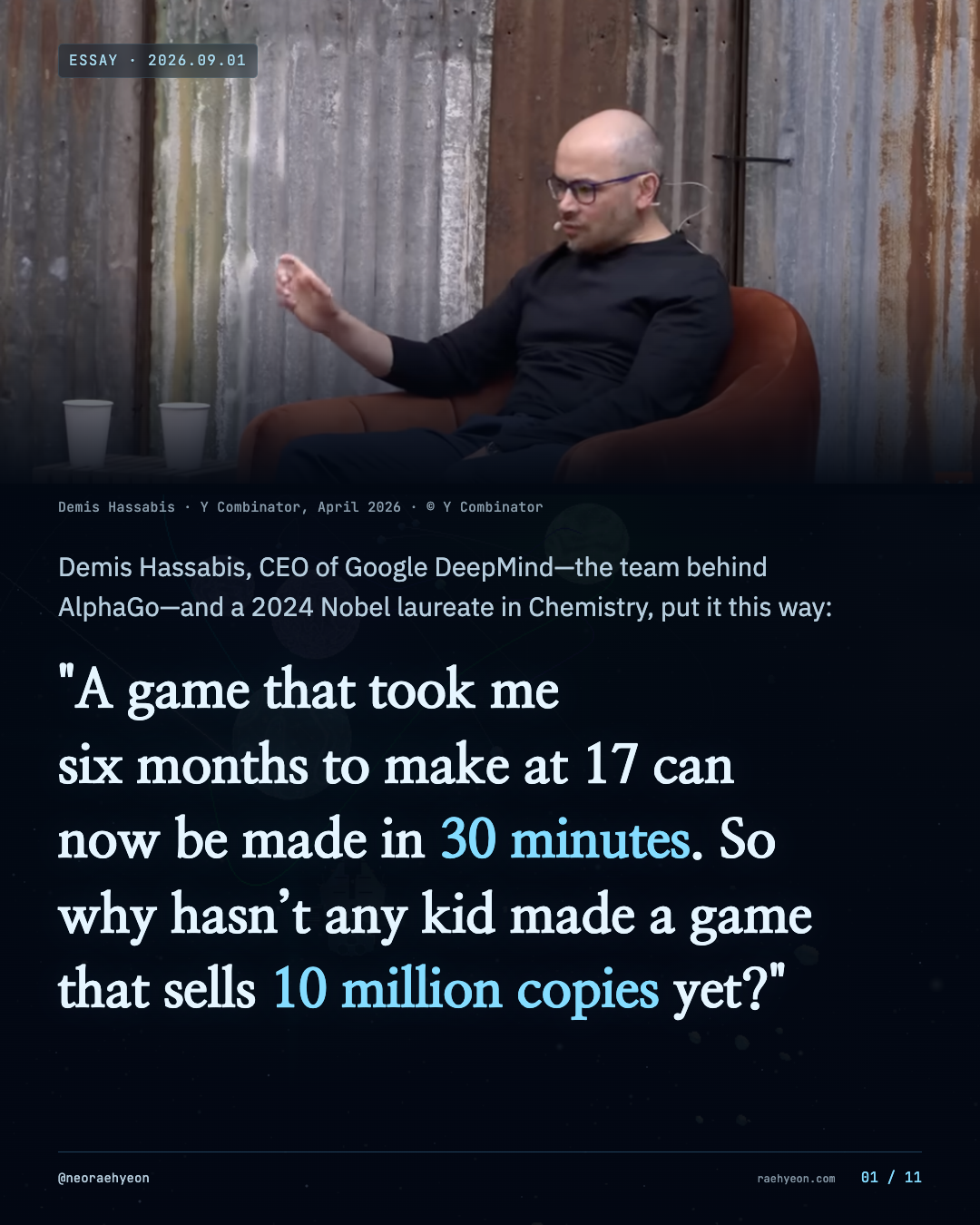
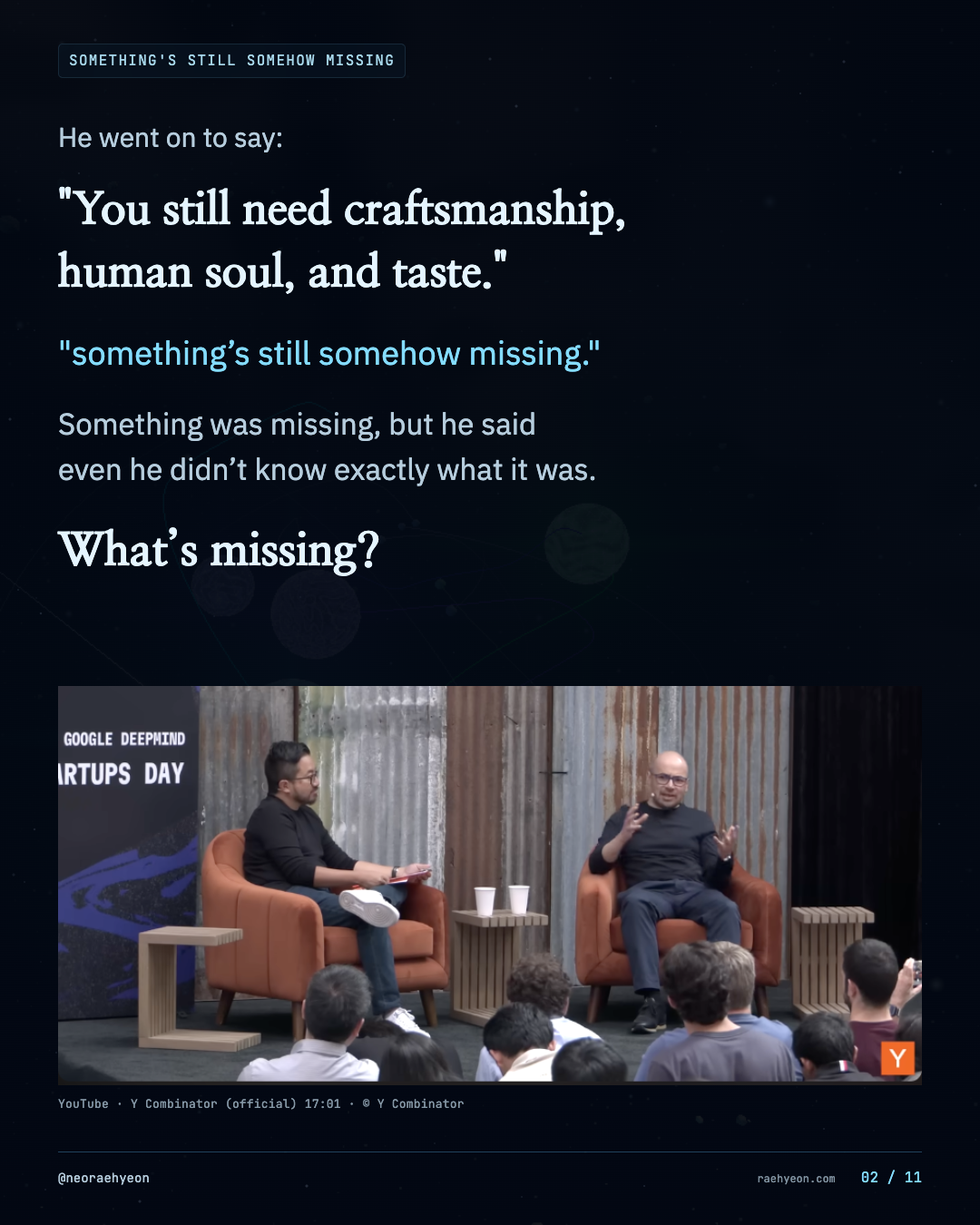
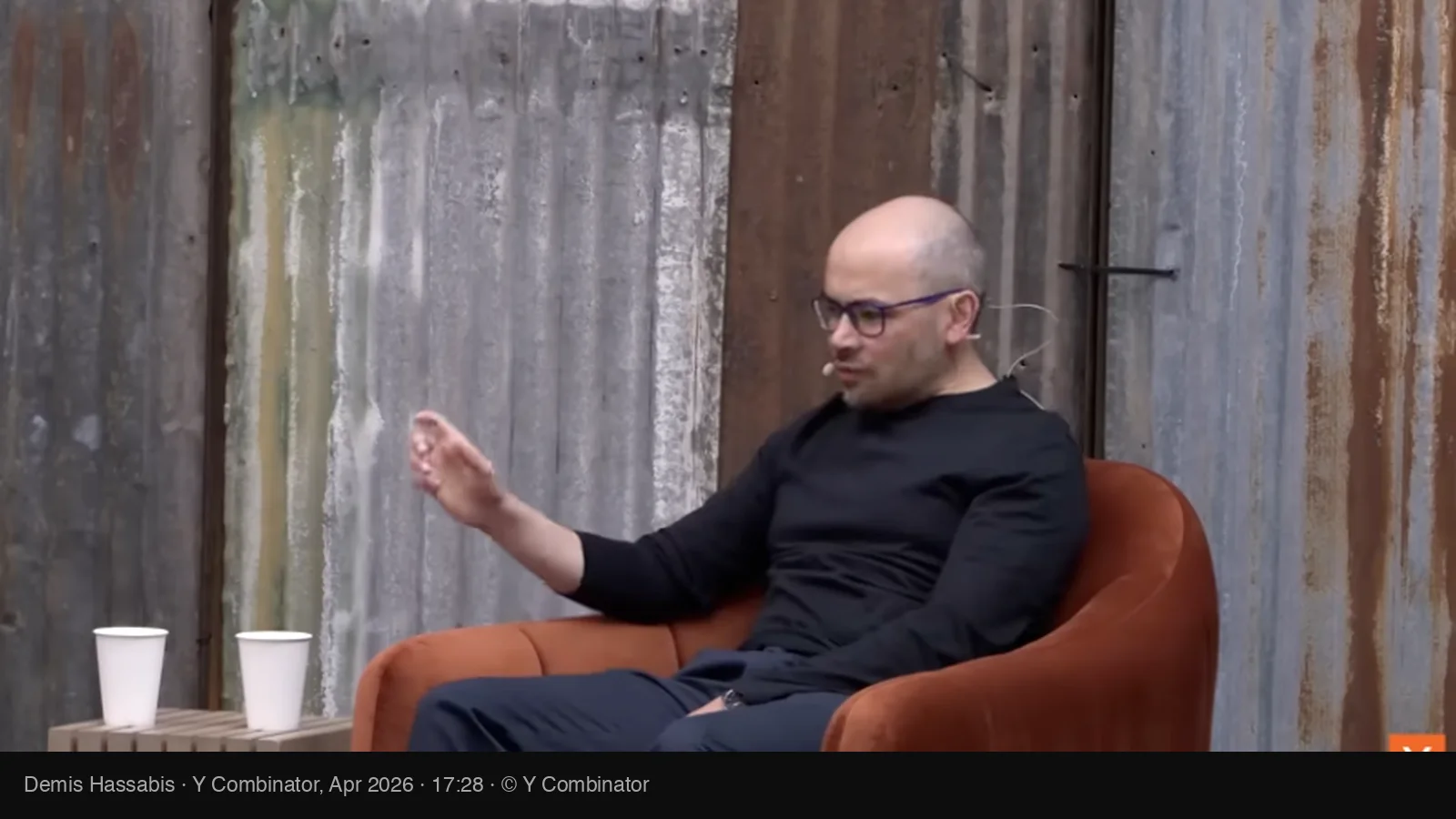
Demis Hassabis said this at Y Combinator in April this year.
"I can do a prototype of theme park in half an hour now which took me 6 months back when I was 17. … why haven't we seen a kid making a hit game that's that sells 10 million copies, right? That should be possible given the effort that's gone in."
Theme Park is a 1994 business simulation game, and Hassabis was on the team that built it. He was seventeen.
This is a question from someone who can now rebuild in thirty minutes what once cost him half a year. And he said something else:
"…but it still needs craft and you know, human sort of soul into it and taste."
Craft. Human soul. Taste. Those, he says, are still required.
"So something's still somehow missing. Maybe it's to do with the process, or maybe it's to do with the tools. I'm not quite sure."
But what exactly is missing, he doesn't know either.
Maybe the process, maybe the tools. He isn't sure.
I keep trying to work out what that missing thing is.
What is it that's missing?
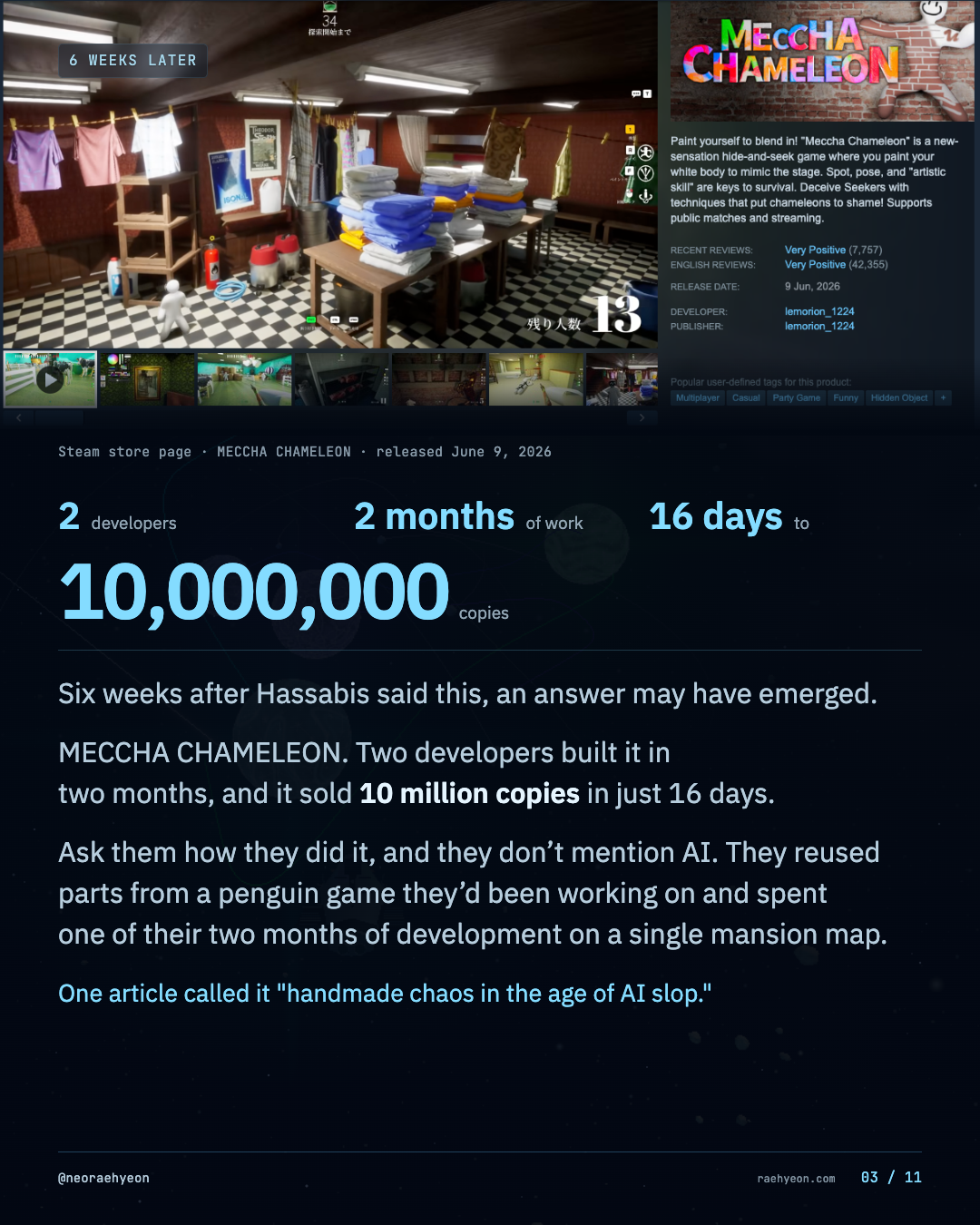
About six weeks after Hassabis asked that question, a game launched that might offer one answer.
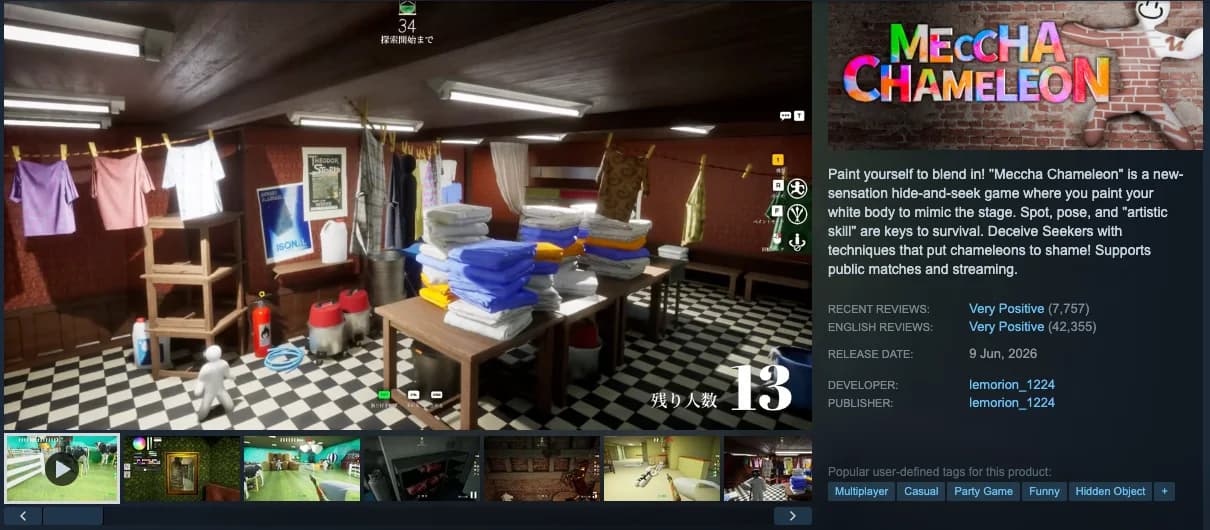
MECCHA CHAMELEON. Two developers, two months of work, ten million copies sold in sixteen days.
In their account of the development process, they emphasized reuse and iteration.
They said they reused parts from an old penguin game, got things existing first and polished them later.
One of those two months went into a single hide-and-seek mansion map.
One article called the game hand-made chaos in an age of AI slop.
I use an aggressive, frankly obsessive amount of AI.
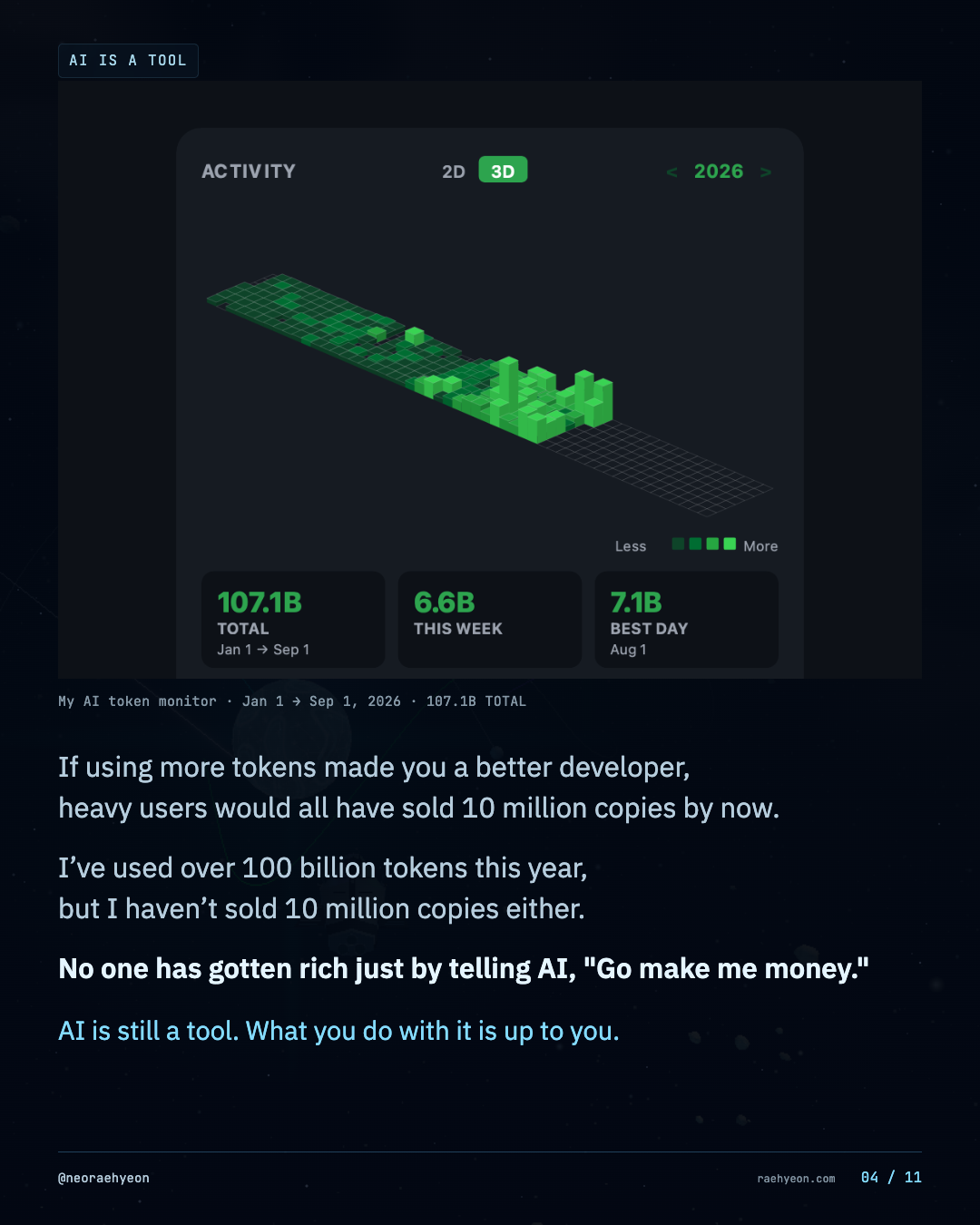
This year, my agents and I have burned more than 100 billion tokens between us.
Around 650,000 calls. 17,000 sessions. Priced against the API, well over ninety thousand dollars.
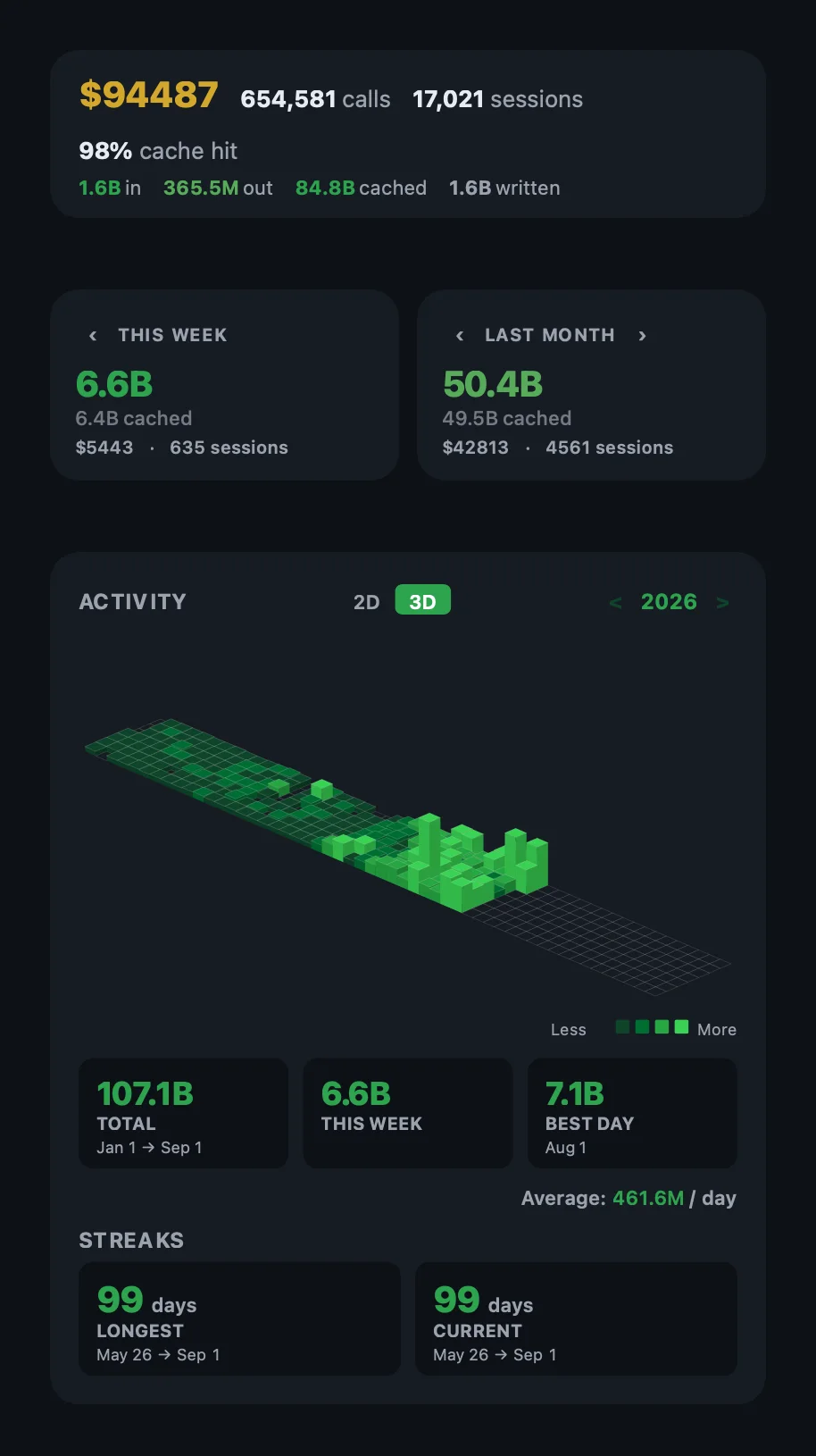
I have spent over 100 billion tokens, and I have not made a game that sells ten million copies.
Spending that much taught me a few things.
AI opinion converges on the average. Each model sits at a slightly different average, but it still collapses into one particular response with very little variation.
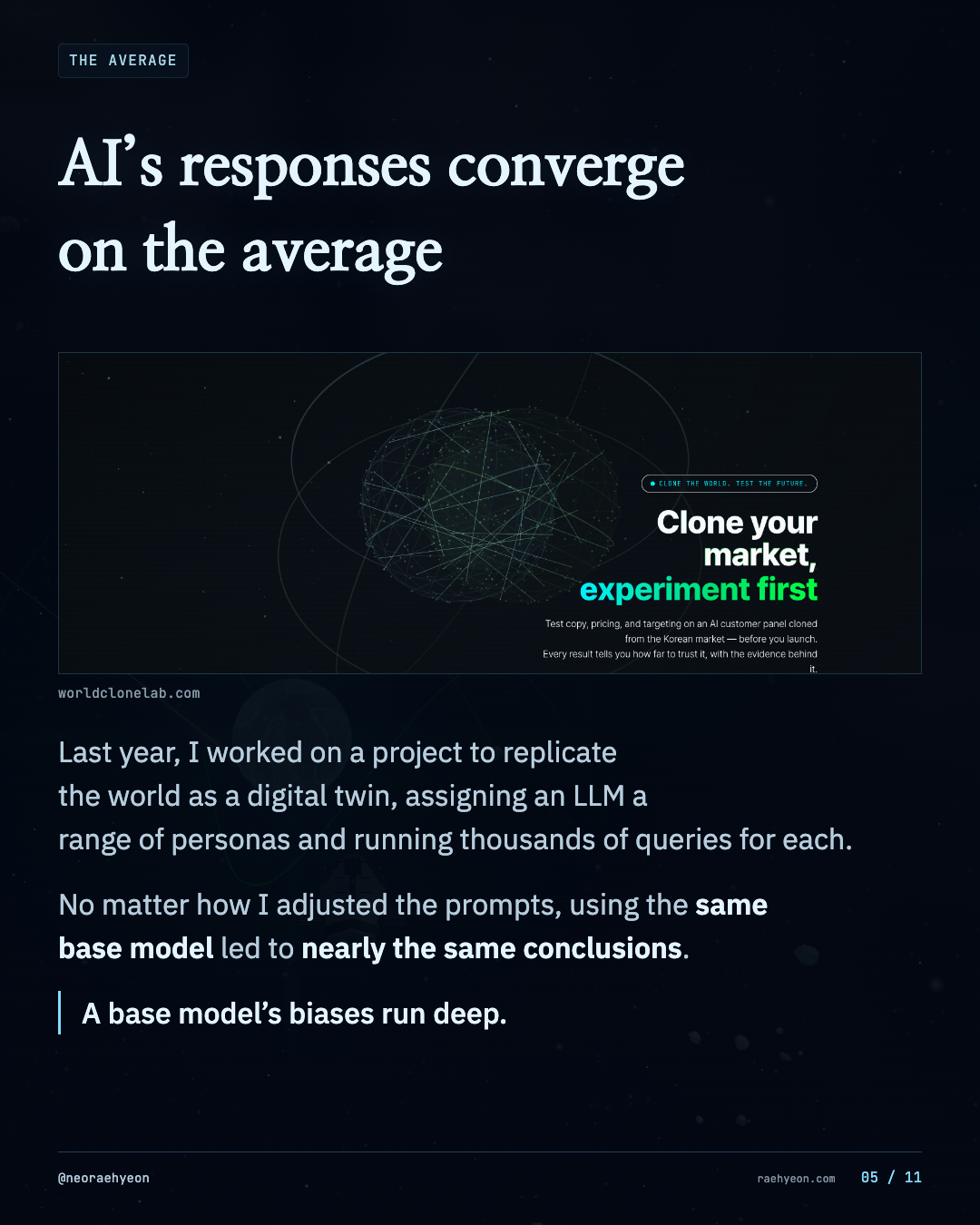
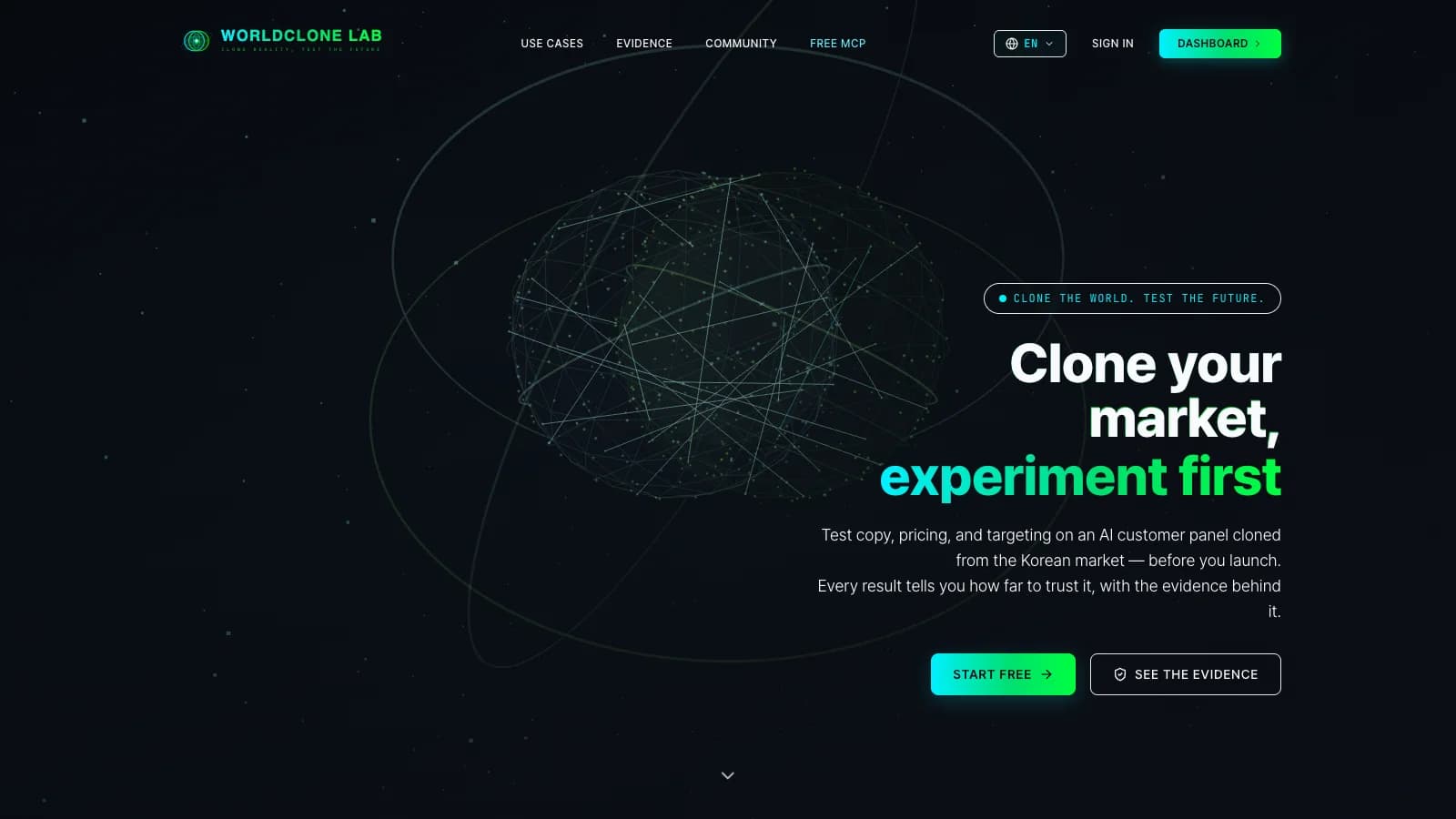
Last year I worked on WorldCloneLab, a project that handed different personas to an LLM and called it many times over, trying to build a digital twin that cloned the world.
No matter how I tuned the prompts, anything sharing a base model converged on nearly identical conclusions and nearly identical answers.
And where I did manage to widen the standard deviation, I was left doubting whether the result reflected reality at all.
The reason, I think, is that most AI grew up on the same training data, the same internet.
The diversity of human beings, each of us grown from an entirely different set of experiences, is something AI does not seem able to have.
Ask AI about almost any idea and it tells you it's good.
Say this one is better and it agrees. Say the other one is better and it agrees again. You have almost certainly seen this yourself.
Research has documented sycophancy in LLMs: a tendency to agree with users rather than prioritize truth. Reinforcement learning from human feedback (RLHF) can reinforce this tendency. I see it as a limitation of the models I use today.
It's mimicking a human trait: preferring well-written flattery over the correct answer.
Fewer and fewer developers read the code themselves.
I no longer read every line of code myself.
AI writes decent code very fast, and there's no reason to give up that speed.
The problem is choosing. Deciding. Which structure makes a good architecture. Which feature users actually need. Who the team needs. Which feature to keep and which to kill.
Faced with these, AI gathers evidence diligently and reaches a conclusion of sorts — but it still has too many blind spots and too much bias.
An LLM is a statistical prediction model. It mostly predicts, from data learned on the internet, the highest-probability words and the words people most commonly like to hear.
There is a kind of decision-making I do not think current LLMs handle well, given their tendency toward popular, average, agreeable answers. I think that kind of decision-making comes from people and their philosophy.
I do not think today's AI can reliably make the decisions a startup faces when it takes a path nobody has taken before.
The decisions made by founders who changed the world were never close to the average. They looked, if anything, impossible.
An LLM still struggles to make a decision that is illogical and brilliant at once.
If the outliers who changed the world had chosen close to the average, they could not have changed it.
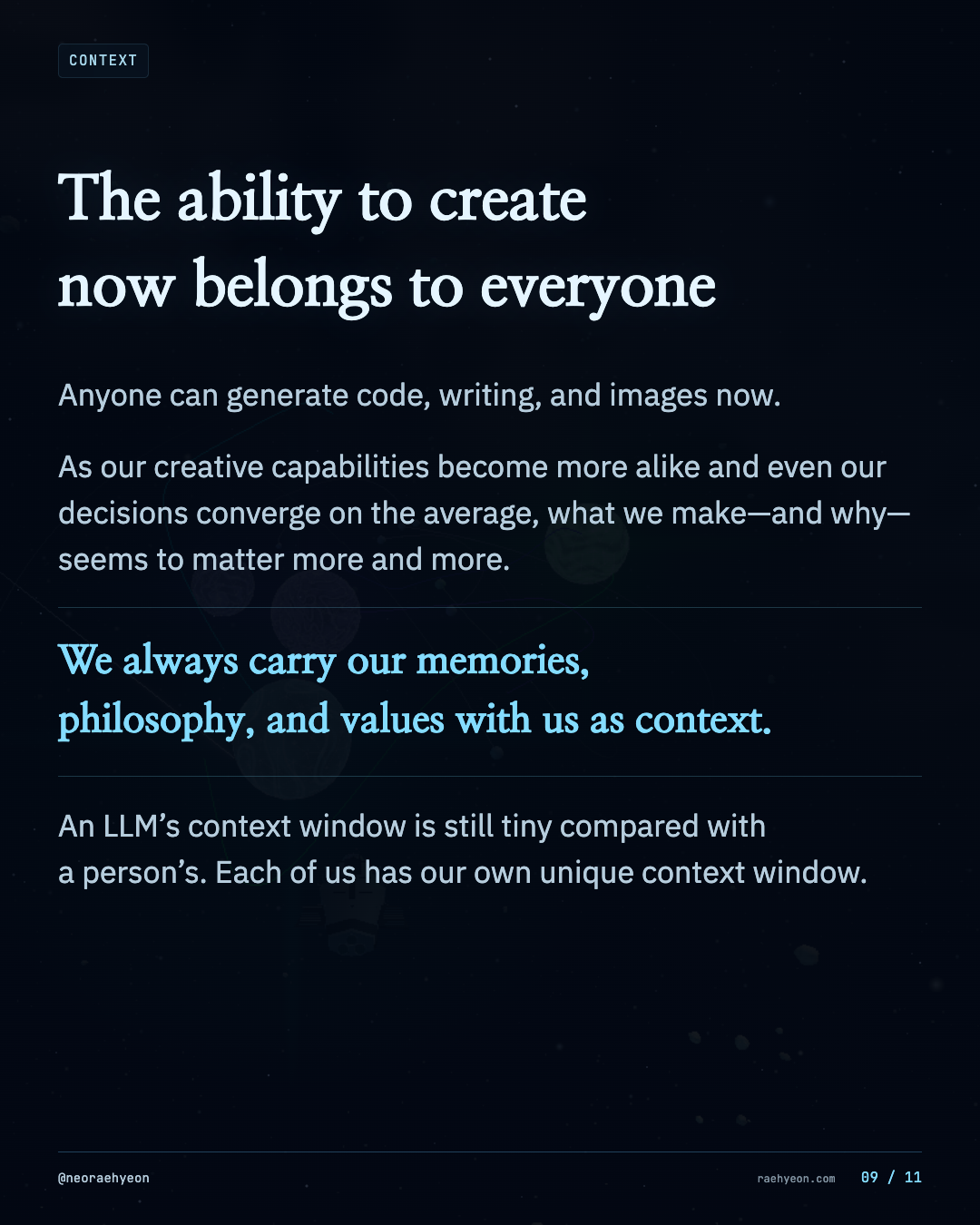
The ability to make things belongs to everyone now.
Code, writing, images — anyone pulls them out easily. The more the things we can make look alike, and the more our choices and decisions converge on a popular average, the more it matters what we make and why.
Today's public LLMs seem to struggle with the kind of value judgments that come from a person's own philosophy and lived experience.
Or perhaps that part simply isn't public. An LLM might make a dangerous, Thanos-shaped value judgment.
A person carries the whole of a lived memory and experience as context. Next to that, an LLM's context window is still far too small.
And that context is different for every single person.
Unlike models raised on much the same vast internet data, each person grows through a different stretch of time and a different set of experiences.
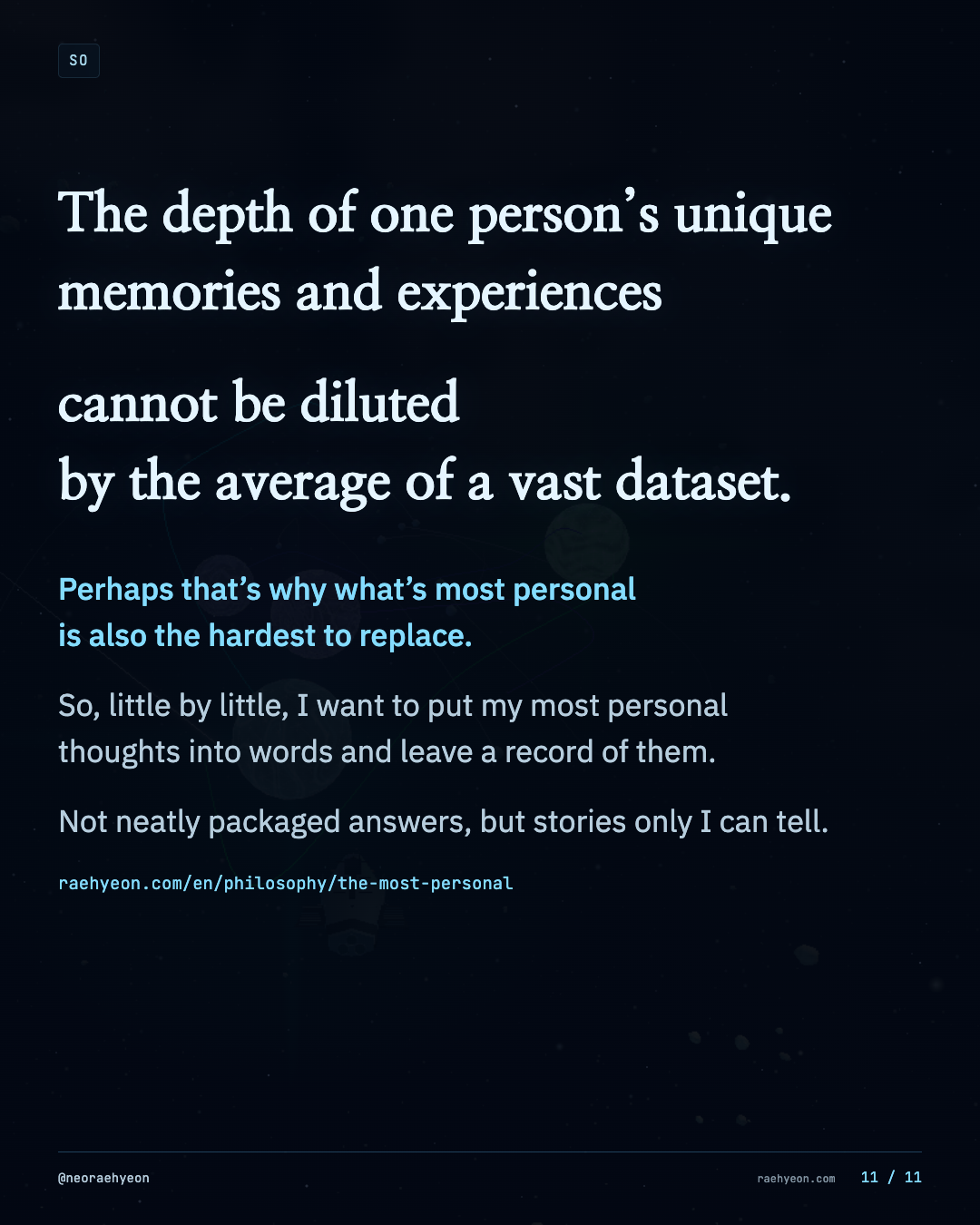
The depth of one person's unique memory and experience does not dissolve into the average of a vast dataset.
And so the most personal seems to become the hardest thing to replace.
I think the following quote could offer an answer to what Hassabis called something missing.
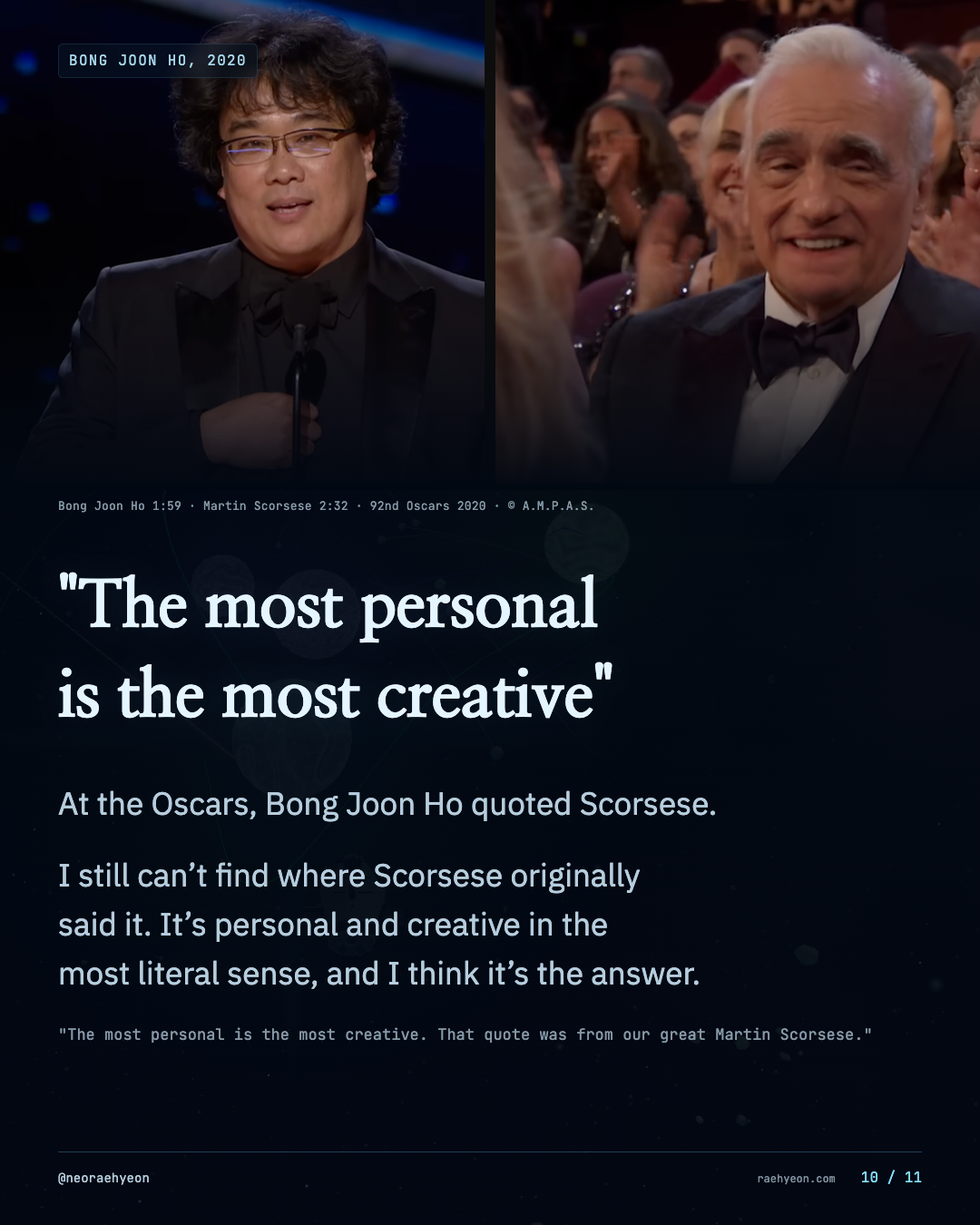
At the Academy Awards in February 2020, Bong Joon Ho said this in his acceptance speech.
"The most personal is the most creative."
He said he had carved the line into himself while studying film as a young man — and then he named whose line it was.
"The most personal is the most creative. That quote was from our great Martin Scorsese."
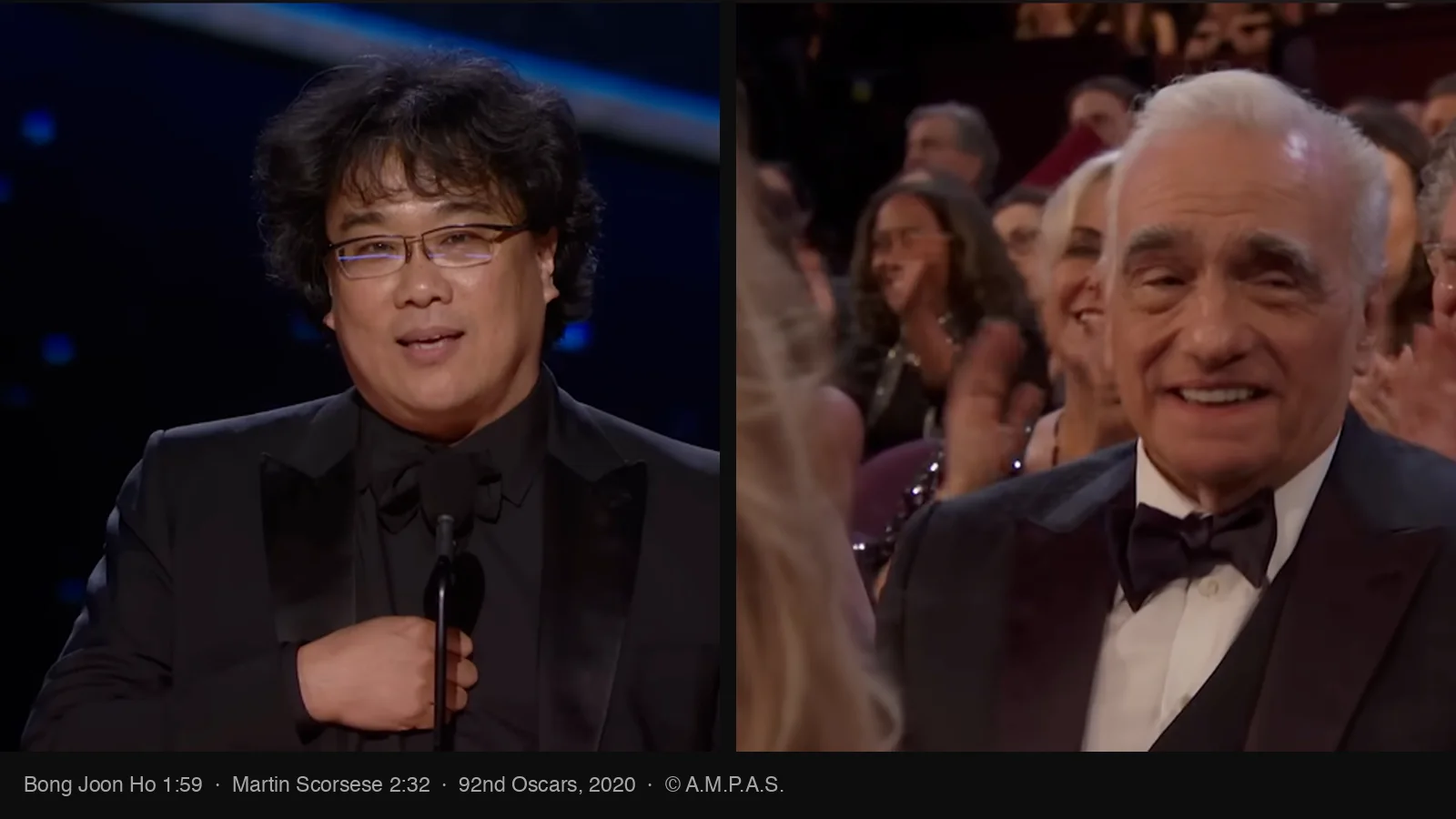
A young man picked up a sentence, carved it into himself, carried it for decades, and handed it back to its owner on the largest stage in the world.
I have not been able to find when or where Scorsese originally said it. There is something about that elusive origin that seems consistent with what the sentence means.
Maybe we owe Bong Joon Ho some thanks for making such a personal line public.
The people who know me — the ones who talked with me at meetups until dawn, the ones who built products with me — know which philosophies I love, which convictions and values I argue for, and how I make decisions.
Why a startup. Why I keep living each day. What choices I make, and on what grounds.
I have never written any of this down, so the values and philosophy that made me still live only in my head and in those people's memories.
What I think now will not last forever and will not always be right. Even so, leaving a snapshot of Unique Human Thinking feels like something worth doing in an age of AI.
So, little by little, I'm going to write the most personal things down myself.
Not tidy, settled answers — the stories nobody but me could tell.